Advantages & Limitations of Operations Research
Operations research is a robust tool and offers directions in making the best decisions possible given the data available.
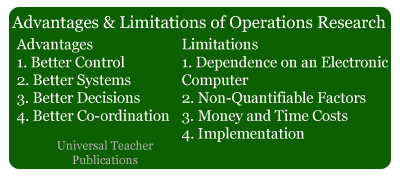
Advantages of Operations Research
Better Systems: Often, an O.R. approach is initiated to analyze a particular problem of decision making such as best location for factories, whether to open a new warehouse, etc. It also helps in selecting economical means of transportation, jobs sequencing, production scheduling, replacement of old machinery, etc.
Better Control: The management of large organizations recognize that it is a difficult and costly affair to provide continuous executive supervision to every routine work. An O.R. approach may provide the executive with an analytical and quantitative basis to identify the problem area. The most frequently adopted applications in this category deal with production scheduling and inventory replenishment.
Better Decisions: O.R. models help in improved decision making and reduce the risk of making erroneous decisions. O.R. approach gives the executive an improved insight into how he makes his decisions.
Better Co-ordination: An operations-research-oriented planning model helps in co-ordinating different divisions of a company.
Limitations of Operations Research
Dependence on an Electronic Computer: O.R. techniques try to find out an optimal solution taking into account all the factors. In the modern society, these factors are enormous and expressing them in quantity and establishing relationships among these require voluminous calculations that can only be handled by computers.
Non-Quantifiable Factors: O.R. techniques provide a solution only when all the elements related to a problem can be quantified. All relevant variables do not lend themselves to quantification. Factors that cannot be quantified find no place in O.R. models.
Distance between Manager and Operations Researcher: O.R. being specialist's job requires a mathematician or a statistician, who might not be aware of the business problems. Similarly, a manager fails to understand the complex working of O.R. Thus, there is a gap between the two.
Money and Time Costs: When the basic data are subjected to frequent changes, incorporating them into the O.R. models is a costly affair. Moreover, a fairly good solution at present may be more desirable than a perfect O.R. solution available after sometime.
Implementation: Implementation of decisions is a delicate task. It must take into account the complexities of human relations and behaviour.
Operations Research Uses (Role)
Operations research plays an important role in almost all areas of business decisions. Some problems where operational research (OR) approach can be used:
1. Finance, Budgeting and Investments
- Credit policy analysis.
- Cash flow analysis.
- Dividend policies.
- Investment portfolios.
2. Marketing
- Product selection, timing, etc.
- Advertising media, budget allocation.
- Number of salesman required.
- Selection of product mix.
3. Purchasing, Procurement and Exploration
- Optimal buying and reordering.
- Replacement policies
4. Production Management
- Location and size of warehouses, factories, retail outlets, etc.
- Distribution policy.
- Loading and unloading facilities for trucks, etc.
- Production scheduling.
- Optimum product mix.
- Project scheduling and allocation of resources.
5. Personnel Management
- Selection of suitable personnel.
- Recruitment of employees.
- Assignment of jobs.
- Skills balancing.
6. Research and Development
- Project selection.
- Control of R&D projects.
- Reliability and alternative design.


