Techniques of Operations Research
The operations research expert has a wide array of methods and techniques available for solving problems.
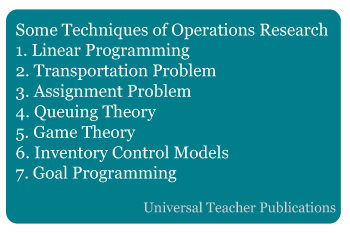
Linear Programming. Linear Programming (LP) is a mathematical technique of assigning a fixed amount of resources to satisfy a number of demands in such a way that some objective is optimized and other defined conditions are also satisfied.
Transportation Problem. The transportation problem is a special type of linear programming problem, where the objective is to minimize the cost of distributing a product from a number of sources to a number of destinations.
Assignment Problem. Succinctly, when the problem involves the allocation of n different facilities to n different tasks, it is often termed as an assignment problem.
Queuing Theory. The queuing problem is identified by the presence of a group of customers who arrive randomly to receive some service. This theory helps in calculating the expected number of people in the queue, expected waiting time in the queue, expected idle time for the server, etc. Thus, this theory can be applied in such situations where decisions have to be taken to minimize the extent and duration of the queue with minimum investment cost.
Game Theory. It is used for decision making under conflicting situations where there are one or more opponents (i.e., players). In the game theory, we consider two or more persons with different objectives, each of whose actions influence the outcomes of the game. The game theory provides solutions to such games, assuming that each of the players wants to maximize his profits and minimize his losses.
Inventory Control Models. It is concerned with the acquisition, storage, handling of inventories so as to ensure the availability of inventory whenever needed and minimize wastage and losses. It help managers to decide reordering time, reordering level and optimal ordering quantity.
Goal Programming. It is a powerful tool to tackle multiple and incompatible goals of an enterprise.
Simulation. It is a technique that involves setting up a model of real situation and then performing experiments. Simulation is used where it is very risky, cumbersome, or time consuming to conduct real study or experiment to know more about a situation.
Nonlinear Programming. These methods may be used when either the objective function or some of the constraints are not linear in nature. Non-Linearity may be introduced by factors such as discount on price of purchase of large quantities.
Integer Programming. These methods may be used when one or more of the variables can take only integral values. Examples are the number of trucks in a fleet, the number of generators in a power house, etc.
Dynamic Programming. Dynamic programming is a methodology useful for solving problems that involve taking decisions over several stages in a sequence. One thing common to all problems in this category is that current decisions influence both present & future periods.
Sequencing Theory. It is related to Waiting Line Theory. It is applicable when the facilities are fixed, but the order of servicing may be controlled. The scheduling of service or sequencing of jobs is done to minimize the relevant costs. For example, patients waiting for a series of tests in a hospital, aricrafts waiting for landing clearances, etc.
Replacement Models. These models are concerned with the problem of replacement of machines, individuals, capital assets, etc. due to their deteriorating efficiency, failure, or breakdown.
Markov Process. This process is used in situations where various states are defined and the system moves from one state to another on a probability basis. The probability of going from one state to another is known. This theory helps in calculating long run probability of being in a particular state.
Network Scheduling-PERT and CPM. Network scheduling is a technique used for planning, scheduling and monitoring large projects. Such large projects are very common in the field of construction, maintenance, computer system installation, research and development design, etc. Projects under network analysis are broken down into individual tasks, which are arranged in a logical sequence by deciding as to which activities should be performed simultaneously and which others sequentially.
Symbolic Logic. It deals with substituting symbols for words, classes of things, or functional systems. It incorporates rules, algebra of logic, and propositions. There have been only limited attempts to apply this technique to business problems; however, it is extensively used in designing computing machinery.
Information Theory. It is an analytical process transferred from the electrical communications field to operations research. It seeks to evaluate the effectiveness of information flow within a given system and helps in improving the communication flow.


