Operations Research Phases
Following are the six phases and processes of operational research:
Formulate the problem: This is the most important process, it is generally lengthy and time consuming. The activities that constitute this step are visits, observations, research, etc. With the help of such activities, the O.R. scientist gets sufficient information and support to proceed and is better prepared to formulate the problem.
This process starts with understanding of the organizational climate, its objectives and expectations. Further, the alternative courses of action are discovered in this step.
Develop a model: Once a problem is formulated, the next step is to express the problem into a mathematical model that represents systems, processes or environment in the form of equations, relationships or formulas. We have to identify both the static and dynamic structural elements, and device mathematical formulas to represent the interrelationships among elements. The proposed model may be field tested and modified in order to work under stated environmental constraints. A model may also be modified if the management is not satisfied with the answer that it gives.
Select appropriate data input: Garbage in and garbage out is a famous saying. No model will work appropriately if data input is not appropriate. The purpose of this step is to have sufficient input to operate and test the model.
Solution of the model: After selecting the appropriate data input, the next step is to find a solution. If the model is not behaving properly, then updating and modification is considered at this stage.
Validation of the model: A model is said to be valid if it can provide a reliable prediction of the system’s performance. A model must be applicable for a longer time and can be updated from time to time taking into consideration the past, present and future aspects of the problem.
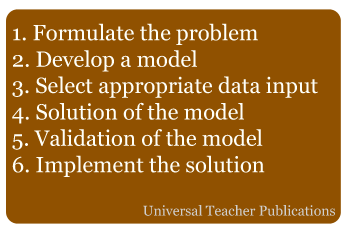
Implement the solution: The implementation of the solution involves so many behavioural issues and the implementing authority is responsible for resolving these issues. The gap between one who provides a solution and one who wishes to use it should be eliminated. To achieve this, O.R. scientist as well as management should play a positive role. A properly implemented solution obtained through O.R. techniques results in improved working and wins the management support.


